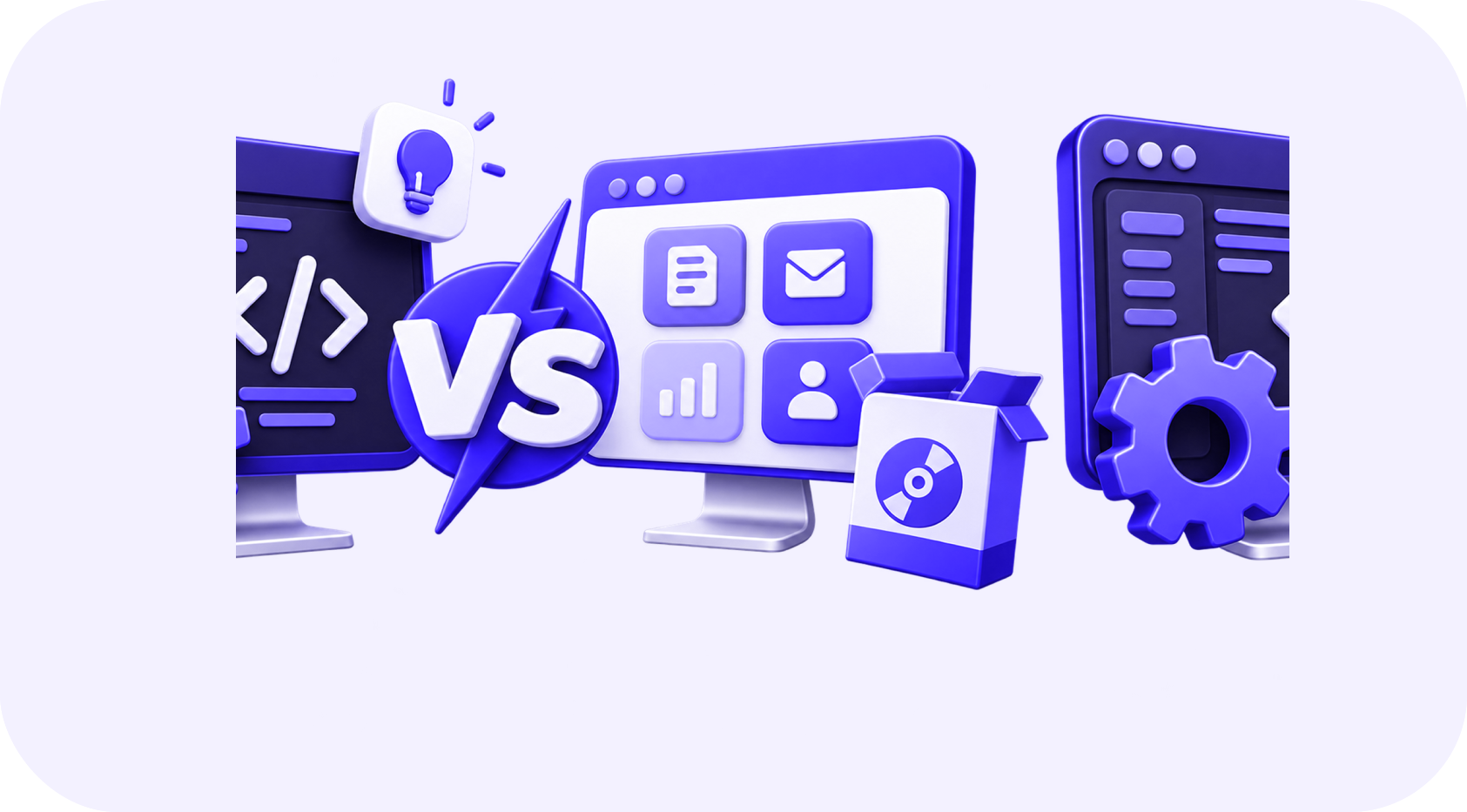
Every growing business eventually reaches a point where its systems begin shaping what the team can and cannot do.
Standard software can provide a fast and affordable starting point. It offers established features, regular updates, and a large user community. But as the business develops unique workflows, employees may build spreadsheets, manual steps, and complicated integrations around the platform.
Custom software offers greater control, but it also requires investment, ownership, maintenance, and disciplined product decisions.
The correct question is not whether custom software is better. It is whether the business problem creates enough value to justify building and owning a system.
01What Is Off-the-Shelf Software?
Off-the-shelf software is designed for many customers. Examples include CRM platforms, project-management products, accounting systems, ecommerce tools, and industry applications.
It is usually the better starting option when:
- The process is common across many businesses
- The platform already meets most requirements
- Speed of implementation is important
- The team has limited development resources
- Industry updates and compliance features are included
- Standard integrations cover the technology stack
The business adapts some of its process to the product in exchange for lower initial effort.
02What Is Custom Software?
Custom software is designed around a specific business model, workflow, customer experience, or data requirement.
It may be appropriate when:
- The workflow creates a meaningful competitive advantage
- Existing platforms require heavy manual work
- Several systems must be unified through one interface
- The business needs unique permissions or data relationships
- Customer experience depends on proprietary functionality
- Licensing cost grows poorly with scale
- The company is building a software product for the market
Custom development can range from a focused internal portal to a complete SaaS platform.
03Compare the Main Tradeoffs
| Factor | Off-the-shelf | Custom software |
|---|---|---|
| Initial launch | Usually faster | Requires discovery, design, and development |
| Initial cost | Usually lower | Usually higher |
| Workflow fit | Based on available configuration | Designed for defined requirements |
| Ownership | Vendor controls roadmap and platform | Business controls product roadmap |
| Maintenance | Vendor handles core product | Business funds ongoing maintenance |
| Integration | Prebuilt options may be available | Can be designed around required systems |
| Scalability | Depends on vendor plans and architecture | Depends on architecture and investment |
| Switching risk | Data and process may depend on vendor | Business must maintain its own system |
Neither option removes risk. It changes who controls the risk and responsibility.
04Calculate the Real Cost
Do not compare a development quotation with one month of software subscription. Evaluate a realistic multi-year period.
For off-the-shelf software, include:
- User and contact-based pricing
- Feature upgrades
- Usage charges
- Add-ons and integrations
- Implementation and consulting
- Manual work caused by product gaps
- Migration and switching cost
For custom software, include:
- Discovery and design
- Development and testing
- Hosting and infrastructure
- Security and monitoring
- Ongoing support
- Product management
- Updates and technical debt
- Documentation and training
The cheapest option at launch may not have the lowest total ownership cost.
05Consider Configuration Before Custom Development
Many businesses can solve their problem through better configuration, automation, and integration rather than a complete custom build.
A practical progression is:
Improve the existing process
Remove unnecessary steps before applying technology.
Configure the current platform
Use fields, permissions, workflows, templates, and reporting properly.
Connect specialist tools
Use stable integrations to remove repeated data entry.
Build a custom layer
Create a portal, dashboard, mobile experience, or service around existing systems.
Build a complete platform
Choose this when ownership of the complete system creates clear strategic value.
06When Workarounds Become a Warning Sign
Custom development deserves serious consideration when employees spend significant time copying data, the same limitation affects revenue repeatedly, or the business cannot deliver its intended customer experience within existing tools.
Other warning signs include:
- Critical operations depend on fragile spreadsheets
- Several platforms store conflicting customer information
- Permissions cannot match the operating model
- Reporting requires manual reconciliation every month
- The vendor cannot support an essential integration
- The roadmap depends on features the vendor will not build
Measure the cost and impact of these problems before deciding.
07Reduce Custom Software Risk
Do not begin by building every desired feature. Start with discovery and define the users, business outcome, required workflows, data, integrations, security, and success measurements.
Build a focused first version. Test it with real users and improve based on evidence.
Use:
- Clear product ownership
- Version-controlled code
- Automated testing where valuable
- Separate test and production environments
- Monitoring and backups
- Secure access and secrets management
- Technical and user documentation
- A maintenance roadmap
Custom software is an ongoing product, not a one-time file delivery.
08A Hybrid Approach Often Works Best
Businesses rarely need to build accounting, email delivery, payments, identity, and every other capability from the beginning. A custom application can create the unique experience while dependable platforms handle standard functions.
For example, a construction company might build a custom operations portal while integrating an accounting platform. A real estate firm might create a proprietary deal workflow while keeping a proven communication system.
This approach concentrates investment on the functionality that creates differentiation.
09Make the Decision From Business Value
Choose off-the-shelf software when the process is standard and the platform meets the requirement without damaging efficiency or customer experience.
Choose custom software when the workflow is strategically important, the limitations are measurable, and the business is ready to own the product over time.
The best decision may also be to configure, integrate, or extend what you already have.
Written by
The InvexTech Team
We design and build AI, CRM and software systems for growing businesses, and write about what we learn doing it.