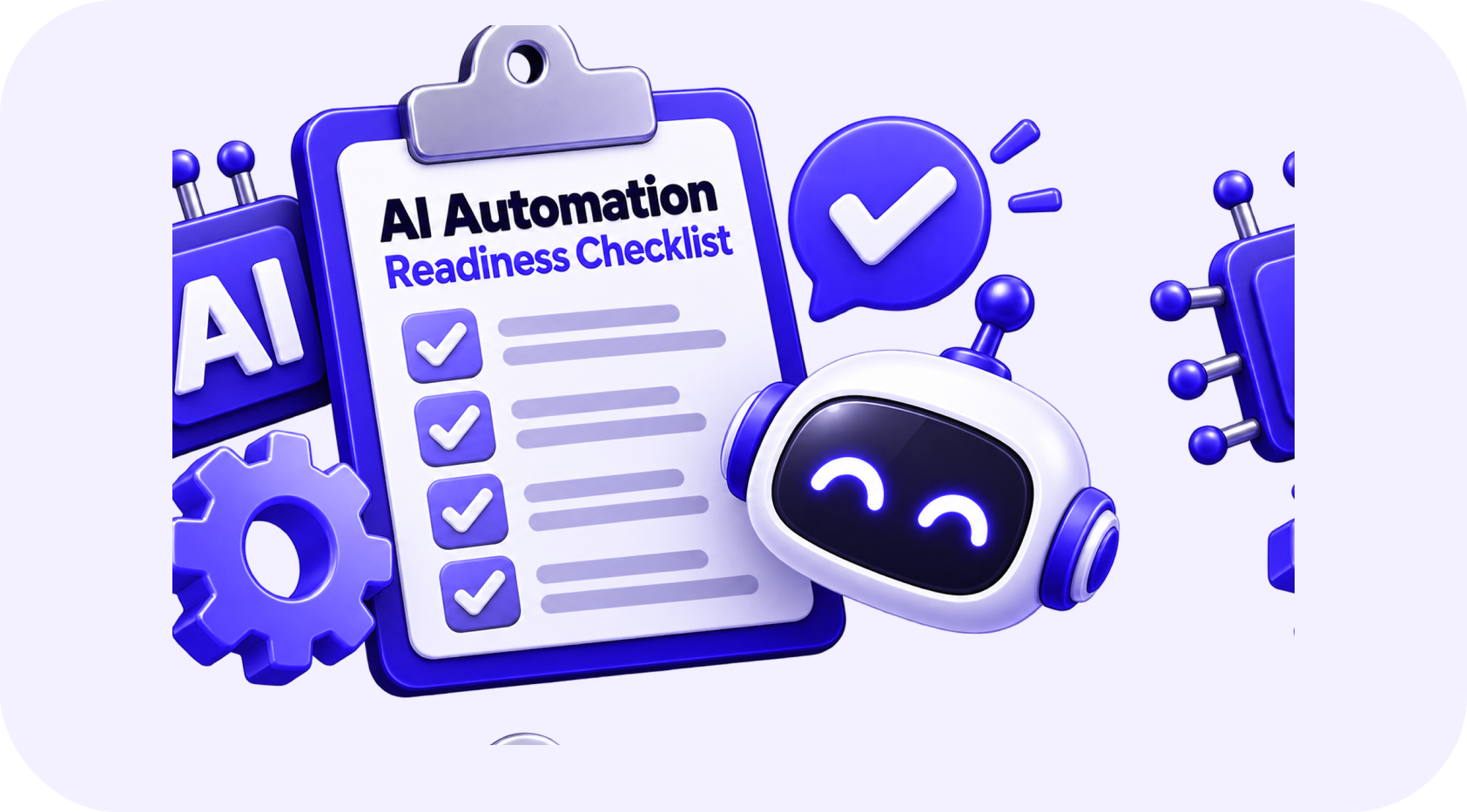
AI can answer questions, summarize conversations, classify information, recommend actions, and operate across business systems. These capabilities create real opportunities, but they do not automatically create a reliable solution.
Many AI projects struggle because the underlying process is unclear, the information is outdated, systems are disconnected, or nobody owns the result. Automating this environment can make confusion move faster.
AI readiness means understanding the problem, preparing the information, defining responsibility, and measuring whether the solution improves the business.
A company does not become AI-ready by buying an AI tool. It becomes ready by creating the conditions for the tool to work safely and usefully.
011. Business Problem Readiness
Start with a specific operational problem, not a general instruction to use AI.
Ask:
- Which task or decision needs improvement?
- Who completes it today?
- How often does it happen?
- What information is required?
- Where does delay or error occur?
- What would a successful result look like?
- What is the current cost in time, money, or customer experience?
A focused goal such as reducing the time required to classify support requests is easier to design and measure than building a general AI assistant for the whole company.
022. Process Readiness
AI cannot follow a process the business cannot explain.
Document the current workflow, including triggers, inputs, decisions, exceptions, approvals, outputs, and owners. Identify unnecessary steps before introducing automation.
- Ready
- The team agrees on the normal process and major exceptions.
- Not ready
- Each employee completes the work differently and no one can define the correct outcome.
Standardization does not mean removing all flexibility. It means knowing where judgement is required.
033. Data Readiness
AI systems depend on the information they receive. Review whether your data is accurate, accessible, current, and properly governed.
Check:
- Documents have clear owners and review dates.
- Duplicate and conflicting records are identified.
- Important fields use consistent formats.
- Customer permissions and consent are recorded.
- Private information is classified.
- Outdated policies are removed or archived.
- Data can be accessed through stable methods.
- Sources can be traced when an answer is produced.
If employees do not trust the CRM or knowledge base, an AI agent connected to it will not solve the trust problem.
044. Technology Readiness
List the systems involved and how they can exchange information.
| Area | Readiness question |
|---|---|
| CRM | Are contacts, stages, owners, and activities reliable? |
| Knowledge | Are approved documents organized and searchable? |
| Integrations | Are APIs, webhooks, or secure connectors available? |
| Identity | Can the system verify users and permissions? |
| Monitoring | Can errors, costs, and actions be observed? |
| Recovery | Can failed or incorrect actions be reversed? |
Do not give an AI agent broad access simply because integration is possible. Provide the minimum permission needed for the use case.
055. Security and Privacy Readiness
Understand what data enters the model, where it is processed, how long it is retained, and who can access the output.
Review:
- Vendor security and contract terms
- Encryption and authentication
- Role-based access
- Logging and auditability
- Data retention and deletion
- Sensitive-data filtering
- Regional and industry obligations
- Incident response
- Human approval for high-impact actions
Healthcare, financial, legal, employment, and other sensitive workflows require stronger review.
066. Knowledge Readiness
An AI assistant needs a defined and approved knowledge source. Collect the documents, FAQs, procedures, policies, and product information relevant to the task.
Remove duplicates and resolve contradictions. Add useful metadata such as department, product, country, audience, effective date, and access level.
Decide what the assistant should do when the answer is unavailable. A safe refusal or human escalation is better than an unsupported response.
077. Team Readiness
AI changes roles and responsibilities. Employees need to understand what the system does, what it does not do, and how to report problems.
Assign:
- A business owner responsible for the outcome
- A technical owner responsible for operation
- Subject experts who approve knowledge and rules
- Security or compliance reviewers where required
- Users who test real scenarios
- A person responsible for ongoing improvement
Involve the employees currently completing the work. They understand exceptions that may not appear in management documents.
088. Measurement Readiness
Record baseline performance before launching. Depending on the use case, measure:
- Completion time
- Response time
- Accuracy
- Human correction rate
- Escalation rate
- Cost per completed task
- Customer satisfaction
- Conversion or retention
- Workflow failure rate
- AI usage cost
An AI system that produces impressive demonstrations but does not improve an important outcome is not a successful implementation.
099. Human-Control Readiness
Define the actions AI may complete independently, the actions requiring approval, and the actions it must never perform.
- Low risk
- Summarizing a meeting for internal review.
- Medium risk
- Drafting a customer response that an employee approves.
- Higher risk
- Changing a payment, deleting an account, making a regulated recommendation, or sending sensitive communication.
Use stronger controls as impact increases.
1010. Pilot Readiness
A strong first project has a narrow scope, enough volume to measure, available data, and manageable risk.
Select one workflow
Choose a problem with clear value and an engaged owner.
Define boundaries
State which users, channels, data, and actions are included.
Build a small version
Include logging, fallback, and human review from the beginning.
Test real scenarios
Include incomplete information, unexpected requests, malicious input, system failures, and edge cases.
Compare with the baseline
Review quality, speed, cost, and user experience.
Improve before expanding
Do not scale a workflow the team cannot yet trust.
11Your Final Readiness Check
Your business is ready to begin when it can answer yes to most of these questions:
- We have a specific problem and measurable goal.
- We understand the current process.
- Our required data and knowledge are usable.
- We know which systems must connect.
- Access and security requirements are defined.
- Human approval and escalation rules are clear.
- The team knows who owns the solution.
- We can test with a limited audience.
- We can monitor performance and cost.
- We have a plan for ongoing improvement.
12Start With Readiness, Then Build
AI automation can help a business move faster and serve customers more effectively. Its success depends on the process, information, controls, and people surrounding the model.
Prepare those foundations first. Then begin with a focused workflow that can prove value safely.
Written by
The InvexTech Team
We design and build AI, CRM and software systems for growing businesses, and write about what we learn doing it.